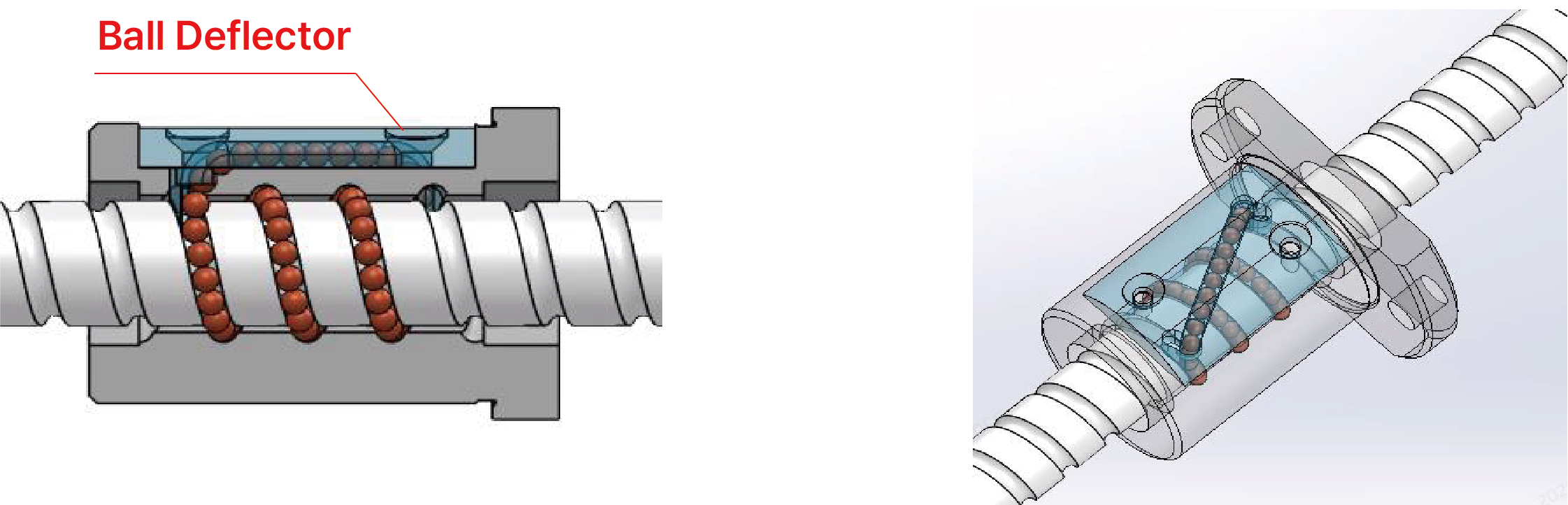
The deflector type uses a deflector or an integrated guide structure installed inside the nut to redirect the ball path and achieve recirculation. Compared with the return tube type, the nut outer diameter can be designed smaller. With a single-circuit design, it provides high load capacity and smooth operation.
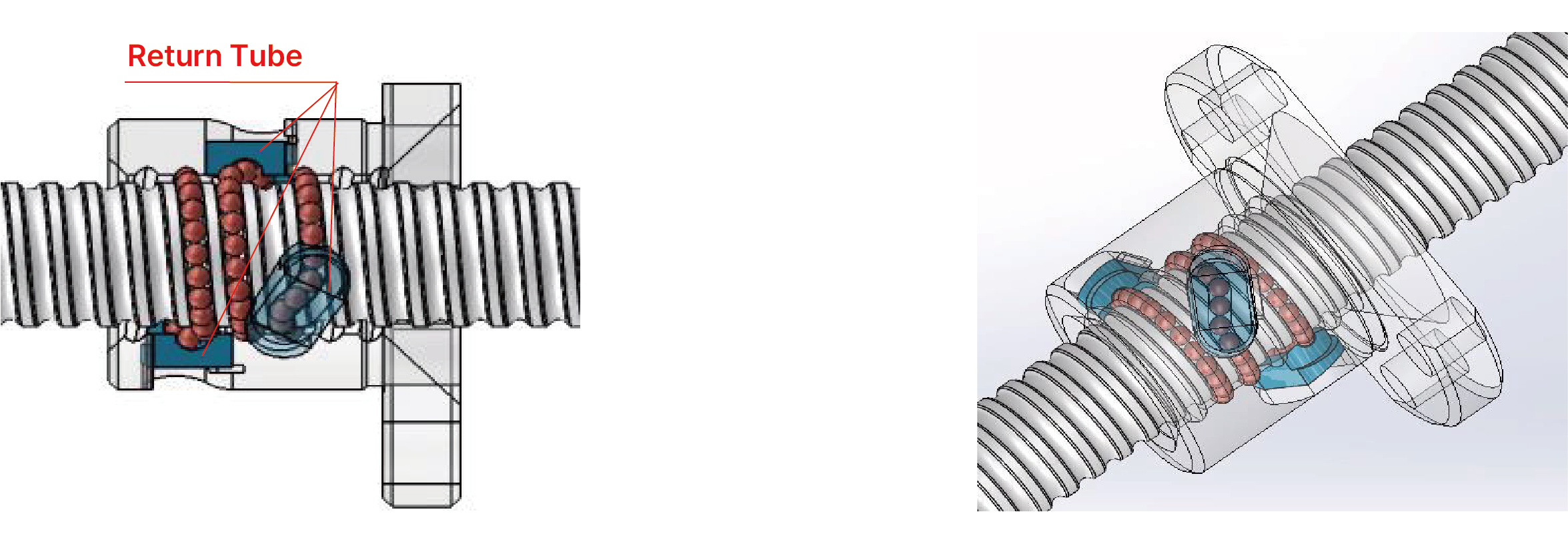
In the return tube type, the balls travel along the raceway between the screw shaft and the nut while carrying the axial load. They then move to an adjacent raceway through the return tube and re-enter the load zone, forming a continuous circulation path.
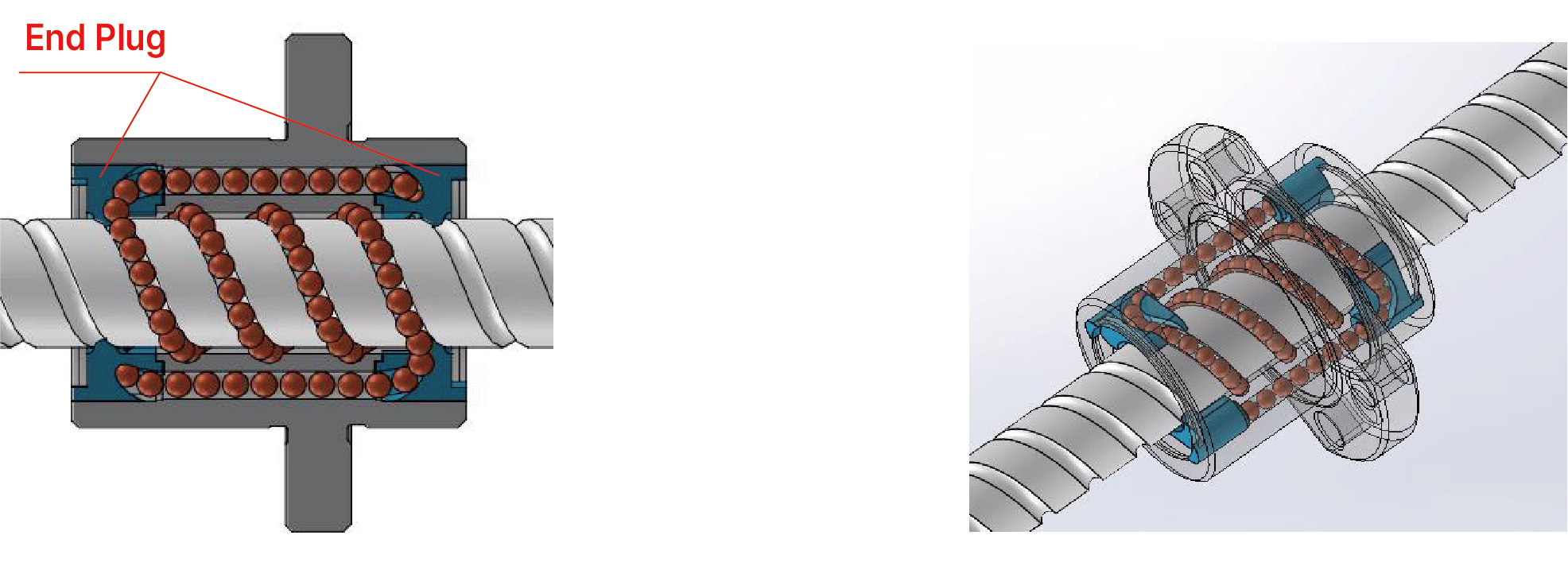
The end deflector type uses an end deflector installed inside the nut to guide the balls into the nut body, allowing them to circulate continuously along raceways in the same direction. Compared with the deflector type, the nut can be designed with a more compact radial dimension, making it particularly suitable for medium lead applications.
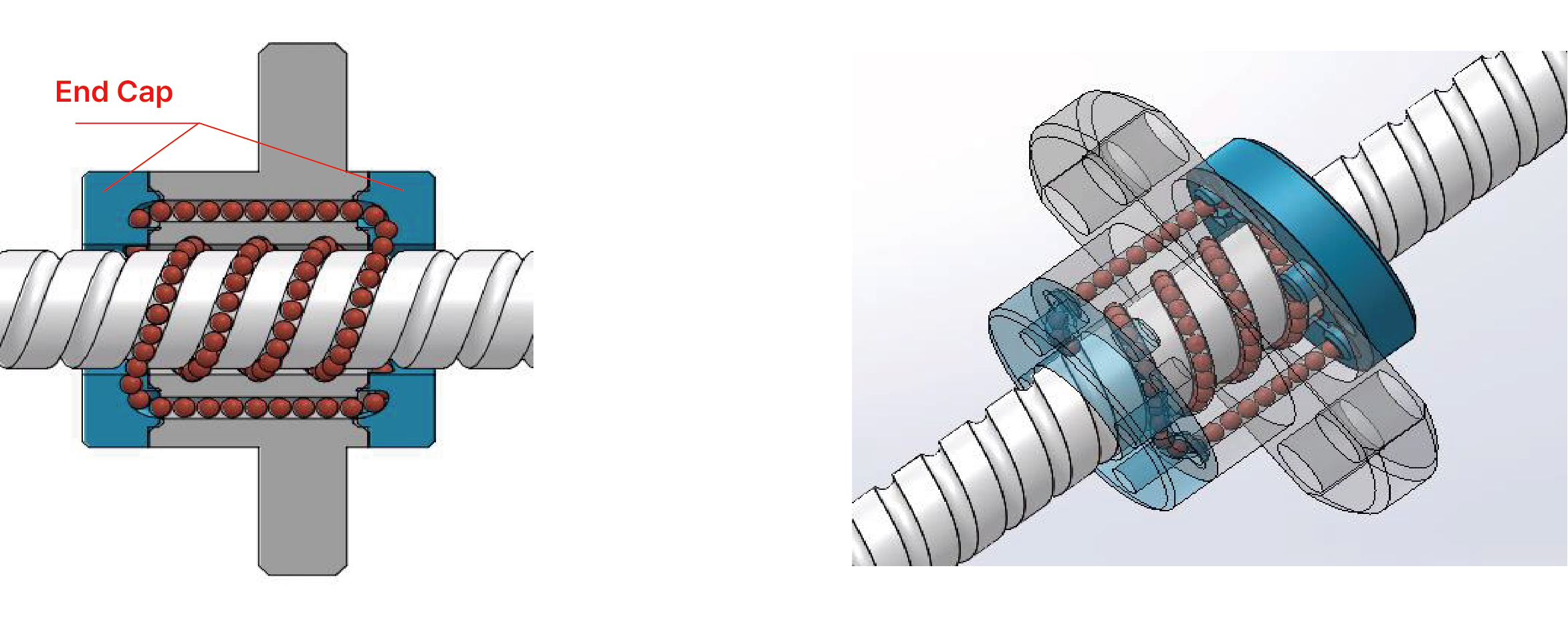
In the end cap type, the balls move along the raceway between the screw shaft and the nut. They are then guided through end caps installed at both ends of the nut and return to the starting point through an internal passage inside the nut body, forming a closed-loop circulation system.
DINGS' ball screws are available in nominal screw shaft diameters from Ø4 mm to Ø14 mm.
The table below shows the reference maximum shaft lengths by accuracy grade. Actual lengths may vary depending on shaft-end configuration, material, and series. For details, please contact our sales engineers.
| Nominal Dia. | Accuracy Grade | |||
|---|---|---|---|---|
| C3 (Ground) | C5 (Ground) | C7 (Rolled) | C10 (Rolled) | |
| 4 | 160 | 170 | 400 | 400 |
| 6 | 240 | 250 | 600 | 600 |
| 8 | 330 | 400 | 600 | 600 |
| 10 | 420 | 450 | 600 | 600 |
| 12 | 510 | 550 | 600 | 600 |
| 14 | 600 | 700 | 600 | 600 |
Notes